
Forced expression or reprogramming factors was pioneered by Prof. Shinya Yamanaka of Kyoto University. In 2006 Prof Yamanaka published his work on murine induced pluripotent stem cells in a groundbreaking article in Cell. Through the forced expression of four reprogramming factors, now termed Yamanaka factors, pluripotency is achieved. About a year later both Yamanaka and James Thomson of the University of Wisconsin published the first results using human cells. Since then a myriad of variations has been published all based on Yamanaka’s´and Thomson’s work. In October 2012, Yamanaka won the Nobel Prize in Medicine for this grounbreaking work.
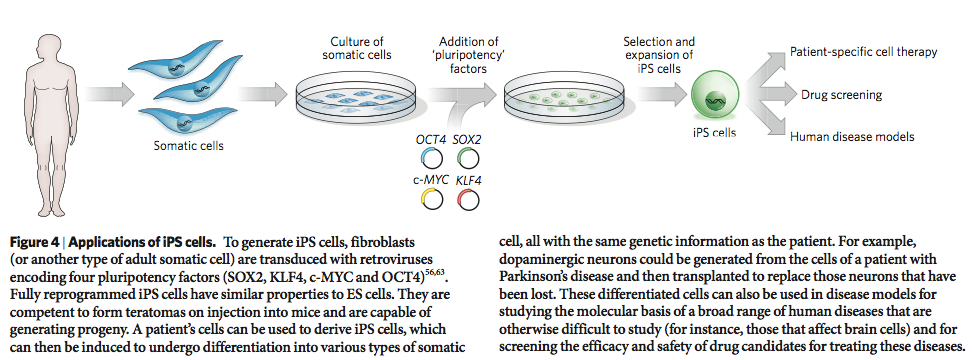
Source: Yamanaka S., et al., Nature, 2010, 465(7299), pp. 704-12
2008: Axiogenesis set up a dedicated iPS laboratory to develop virus-free, traceless and high-efficiency methodologies using 3 as well as 4 factors.
2010: Axiogenesis obtained a license for the Yamanaka patent portfolio from Kyoto University, through its licensing office iPS Academia Japan Inc.
2012: Axiogenesis commercialized its human iPS cell-derived cardiomyocyte product, Cor.4U.
Axiogenesis has also transferred the murine cell business from mouse embryonic stem cells (ESCs) to mouse iPS cells yielding cells with exactly the same characteristics as the original mouse ESC-derived Cor.At cells.
The use of human iPS cells, rather than ESCs as a source, solves a problematic ethical debate especially relevant in Germany. It also opens up many possibilities for clinical applications including cell therapy, gene therapy and whole tissue engineering.
Defined donors with a complete medical history including genetic family history enables us to build up a set of relevant iPS cell lines to test for differential reactions to compounds. This enables us to define the most effective target patients and stratify successful Stage II and Stage III clinical trials.
This also represents the first step towards true pharmacogenomics and eventually fully personalized medicine.
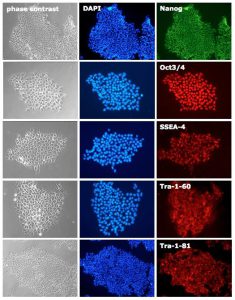
Axiogenesis’ human induced pluripotent stem cells are well-characterized. The image below shows that the cells express intracellular and surface pluripotency markers:
For drug development:
Axiogenesis has applied its proprietary differentiation and selection methodology to produce human cardiomyocytes. These can be used in electrophysiology or toxicity screens. We have vectors and protocols available for a range of different cell types including: several subtypes of neuronal cells, smooth muscle cells, hepatocytes, endothelial cells, etc.
Axiogenesis has produced custom cell types exclusively for pharmaceutical companies. Currently Axiogenesis is offering a compound characterization service using its human iPS-derivedcardiomyocytes (Cor4U®) cells on a microelectrode array (MEA).
Please contact us if you would require customized cells, different cell types or if you require cardiomyocytes or other cell types containing a particular transgene.
For clinical applications:
Axiogenesis was originally founded with a view to develop cell therapies and the Axiogenesis patent portfolio is laid out with clinical applications in mind.
Currently we are developing traceless, high-efficiency reprogramming in house to produce iPS cells with a high frequency and with reproducible characteristics. This together with our mass production technology and selection of pure populations of cells will enable Axiogenesis to translate its technology to clinical applications in the future.